


Daily care · 9 min read
A grooming session usually goes wrong before the brush reaches a knot. The cat is lifted from rest, placed on a slippery surface, held in position, and asked to accept a long sequence with no clear way to leave. By the time the person is trying to help, the setup already feels like restraint.
Make the routine smaller. Observe the coat, invite the cat to a stable familiar place, touch an easy area, make one or two light strokes, and pause. Cat Friendly Homes advises frequent short sessions and notes that many cats accept attention around the head and neck more readily than the belly, hind legs, or under the tail.
Decision aid
The five-signal grooming check
Advance only while the cat and coat pass the current check. Finishing after one calm stroke is more useful than completing a full-body plan through resistance.
| Check | Continue when | Pause or stop when |
|---|---|---|
| Observe | The cat is settled, alert, and able to move away; the skin and coat look familiar. | There is pain, a wound, swelling, a sudden coat change, or the cat is hiding or unwell. |
| Invite | The cat approaches or remains comfortably on a stable familiar surface. | You must chase, lift, corner, or hold the cat in place. |
| Touch | A brief hand touch earns soft or neutral body language. | Skin ripples repeatedly, the tail lashes, ears rotate back, the body lowers, or the cat turns sharply. |
| Brush | One light stroke moves with the coat and the tool does not pull. | Pins catch, the cat flinches, the skin reddens, or pressure is difficult to control. |
| Pause | The cat stays, leans back in, or calmly offers another easy area. | The cat moves away, grooms abruptly, hides, swats, growls, or shows escalating tension. |
Learn the normal coat before trying to improve it
Notice how the coat usually lies, where loose hair collects, how often the cat self-grooms, and which areas are already comfortable to touch. Run your hands lightly over the easy zones during ordinary calm contact so a new lump, tender spot, greasy patch, flaking, hair loss, or tight knot is easier to recognize.
Current Cat Friendly Homes grooming guidance recommends observing normal grooming behavior and building a familiar, predictable routine. A sudden change is information, not a reason to brush harder. The organization’s abnormal grooming guide advises contacting a veterinarian when normal self-grooming or coat condition changes.
Choose the tool for one specific job
A soft silicone glove, slicker brush, comb, shedding tool, and misting brush do not perform the same task. Match the tool to the cat’s coat, the condition of the skin, and the small job in front of you. If you cannot explain what the tool should remove or smooth in this session, start with your hand instead.
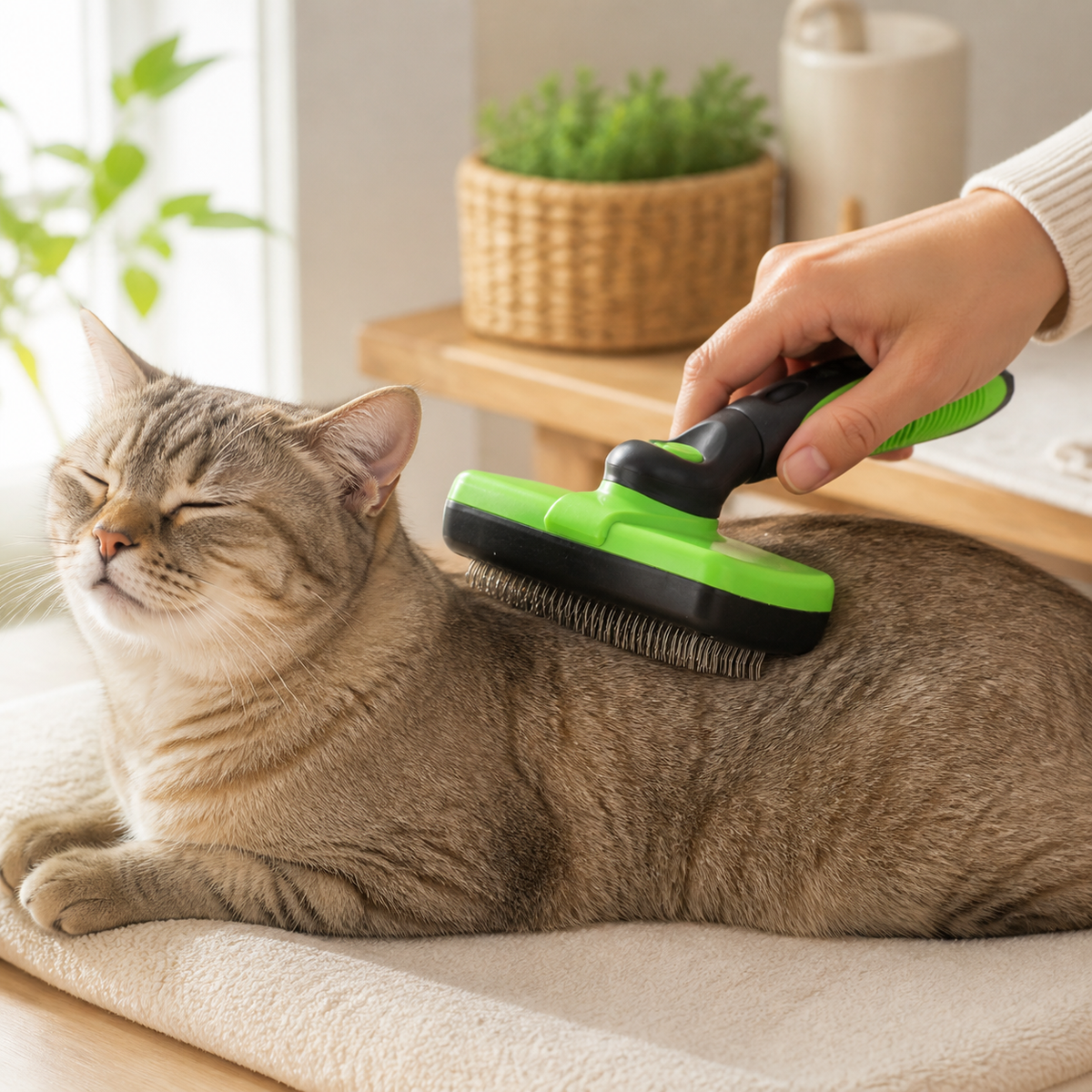
Inspect pins, tips, edges, handles, reservoirs, charging ports, and release mechanisms before use. The self-cleaning cat slicker brush has a broad pinned head; the flexible silicone grooming glove offers a different surface and hand motion. Neither is automatically appropriate for every coat or body area.
- Light loose-hair collection: begin with a soft surface and minimal pressure.
- Long or dense coat: ask a veterinarian or qualified groomer which comb and sequence suit the coat.
- Aerosol, mist, or added liquid: use only when the exact product instructions and the cat’s tolerance support it.
- Tight mat, wound, painful skin, or unknown lump: stop home grooming and seek professional advice.
Invite the cat to a stable familiar place
Choose a time when the cat is calm and the room is quiet. Use a non-slip surface the cat already visits, keep the exit open, and place the tool where it can be seen and sniffed without touching the cat. Do not begin by carrying the cat to a grooming station that appears only for handling.
Start with a brief hand touch near an already accepted area. Many cats prefer the head, cheeks, neck, or upper back to the belly, hindquarters, paws, or tail. Individual preference overrides the map: watch the cat in front of you rather than assuming a body zone is safe because another cat enjoys it.
Use one stroke, then give the answer space
Move with the direction of the coat and use less pressure than the tool’s weight seems to invite. After one or two short strokes, take the brush away and pause. A cat that stays relaxed or leans back toward contact may accept another. A cat that steps away has ended that repetition.
Watch for small changes before a swat: repeated skin twitching, faster tail movement, ears turning sideways or back, head turns toward the tool, a lowered body, sudden grooming, or a shift away. Stop at the early signal. The aim is to keep tomorrow’s invitation possible, not to finish both sides today.
Important condition
Do not punish a warning, force the cat back, or ask another person to hold the cat down so the session can continue. If routine handling is not possible, ask a veterinarian about a safer care plan.
Do not turn a tight knot into a cutting task
A surface tangle and a tight mat against the skin are different problems. Pulling can hurt, and cat skin can be difficult to see beneath a mat. Do not use household scissors close to the body or keep combing through pain. A veterinarian or qualified cat groomer can assess the safest removal method and whether skin disease, pain, mobility, weight, or another health change contributed.
Bathing is also a separate procedure, not the automatic next step after brushing. Use only products documented as safe for cats and only when there is a real reason and a handling plan. Human shampoos, essential oils, fragranced sprays, and improvised liquids do not belong in a grooming tool reservoir.
Clean the tool and keep a two-line log
Remove hair using the documented release method, wash only the parts and materials allowed by the instructions, and dry the tool completely before storage. Keep electrical components dry, inspect every pin and edge, and replace a tool that has bent, corroded, cracked, or loosened parts.
Record the body area, tool, number of strokes, and the first sign that ended the session. The same observation habit supports the water-station placement routine: keep the setup predictable, change one variable, and let the cat’s normal behavior guide the next adjustment. The grooming collection should be a set of possible tools, not a checklist every cat needs.
- Where did the cat choose to stand or sit?
- Which touch or tool surface was accepted?
- How many light strokes happened before the first change?
- Did the coat or behavior look different from the cat’s normal pattern?
Frequently asked questions
How often should I brush my cat?
Frequency depends on coat type, shedding, skin health, age, mobility, season, and the individual cat’s tolerance. Short predictable sessions may be easier than infrequent long ones. Ask your veterinarian or a qualified groomer for a coat-specific plan.
What if my cat bites the brush?
Stop moving the tool and end or simplify the session. Biting can reflect play, investigation, rising arousal, discomfort, or a request for distance. Do not turn the brush into a wrestling toy or continue toward the face.
Can I cut out a mat with scissors?
Do not use household scissors close to a cat’s skin. Tight mats can hide thin, folded, irritated, or painful skin. Ask a veterinarian or qualified cat groomer to assess safe removal and the reason the mat formed.
Make one useful change
Place one clean tool beside a familiar non-slip resting area. When your cat is calm, offer a hand touch, make one light stroke on an easy body zone, pause, and finish while the body remains soft.
This journal provides general educational guidance, not veterinary diagnosis. Contact your veterinarian about health changes, pain, distress, or advice for an individual cat.