

Daily care · 9 min read
A fountain can be perfectly clean, full, and ignored. The usual problem is not that the cat has failed to understand the object. It is that the station asks the cat to drink beside a noisy appliance, with its back to the room, in a route shared with people, dogs, or another cat.
Start with placement, not the product. International Cat Care’s current caregiver guide says the location of water sources matters as much as the container: offer water in quiet places, away from litter trays and busy routes, with easy access and room to see the surroundings. This guide turns that advice into a practical room test.
Decision aid
The five-check water station test
Run this once when you place the station, then repeat it after a week of normal life. A single failed check is a reason to adjust the setup before buying another container.
| Check | What to look for | Smallest useful change |
|---|---|---|
| Access | The cat can approach and leave without squeezing past a wall, person, or another pet. | Pull the station forward or move it to a quieter edge. |
| Separation | Water is away from litter and not crowded against every food resource. | Create a separate water point before replacing the bowl or fountain. |
| Noise | No door, washer, dishwasher, or heavy foot route repeatedly interrupts drinking. | Observe at the busiest hour and relocate if the cat startles or leaves. |
| Care | The basin, pump, filter area, and mat can be reached without a difficult teardown. | Write the cleaning steps beside the station and follow the exact manual. |
| Backup | Fresh still water remains available if the fountain is off, blocked, or being cleaned. | Keep a separate easy-clean bowl in another suitable location. |
Map the drinking route before choosing the container
For two ordinary days, note where your cat already pauses, which rooms stay calm, and which approaches are blocked at busy times. Do not count only the moments you see drinking. A useful station also needs to be available when the home is noisy, when another animal is moving through, and when you are not standing nearby.
The International Cat Care drinking guide recommends multiple sources: at least one per cat plus an additional source, and at least one on every floor. Treat that as a placement framework, not a promise that every cat will use every point equally.
- Mark one quiet location on each occupied floor.
- Keep the approach visible instead of hiding water deep in a dead-end corner.
- Separate stations so one cat or dog cannot control all access.
- Leave a familiar backup bowl while a new fountain is introduced.
Choose between still and moving water by observation
Some cats approach a moving stream readily; others prefer a still, wide container. The useful question is not whether fountains are universally better. It is whether this cat drinks comfortably from this source, in this location, while the source remains practical to clean.
Offer the new fountain beside—rather than immediately instead of—a familiar bowl. Keep both fresh and record which source is used over several days. If the fountain changes the sound, reflection, or approach too much, try the same product in a calmer location before concluding that moving water is the problem.
Important condition
A fountain is an appliance, not a medical treatment. A sudden change in drinking, urination, appetite, energy, or body weight belongs with a veterinarian, not a product experiment.
Give the cat a view and an exit
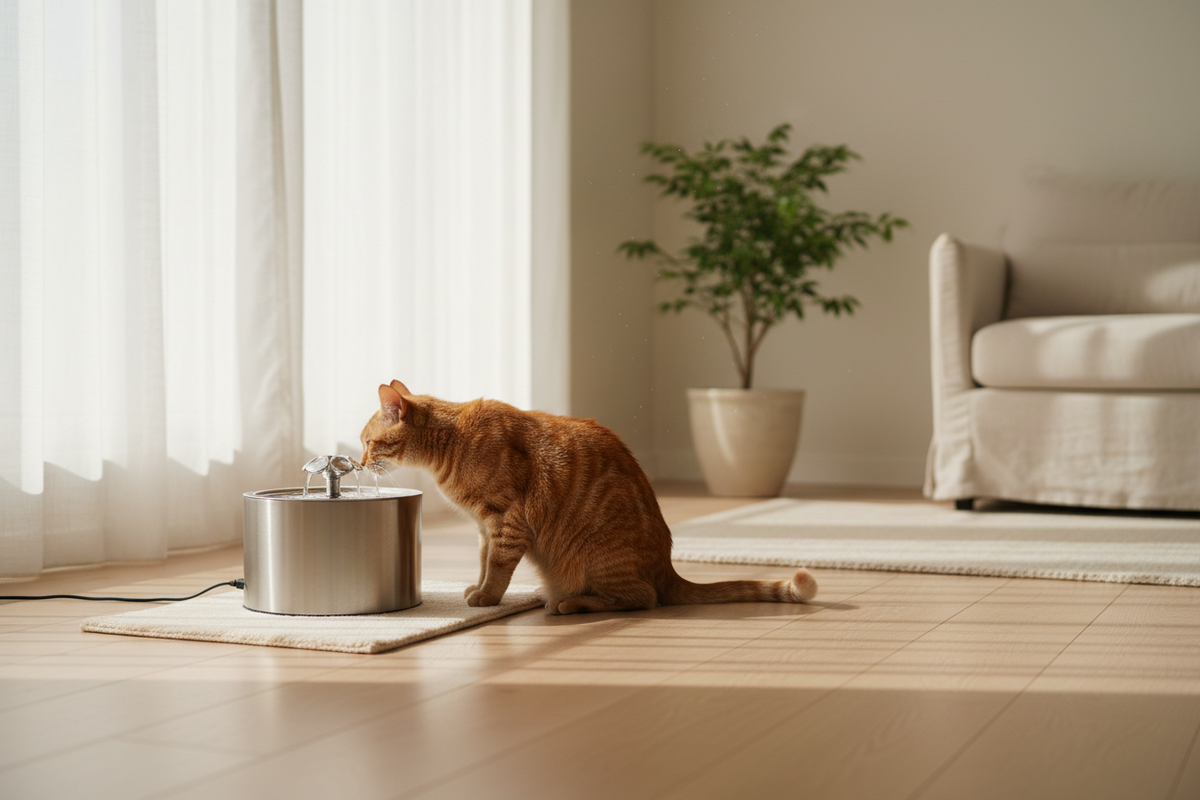
A station pushed hard against a wall can force a cat to turn away from the room. International Cat Care illustrates a fountain placed away from the wall so the cat can monitor the surroundings while drinking. In a small kitchen, even a modest gap and an open side approach can change how exposed the station feels.
Check the full body, not only the bowl. The tail, shoulders, and hind feet need room. Keep the station outside door swings and away from cords that cross a walking route. If a dog shares the home, consider whether height, a gate, or a separate room gives the cat reliable access without creating a risky jump beside water and electricity.
Build a cleaning routine the household can repeat
Fresh water and a clean container matter more than a styled corner. International Cat Care advises providing fresh water daily and cleaning containers regularly—daily if possible—with soap or dishwashing detergent and hot water, followed by thorough rinsing. A fountain also has a pump, filter housing, seams, and cable area, so the exact manufacturer instructions control the safe disassembly and care sequence.
Keep the routine visible: refresh the water, inspect the stream and basin, wipe the mat, and schedule the deeper pump and filter service specified for the exact model. If the current station is so awkward that it is routinely postponed, the setup is not working operationally even if the product looks good.
- Use only cleaning products allowed by the exact product instructions.
- Rinse away detergent and let electrical parts stay dry as directed.
- Replace filters only with the documented compatible part and interval.
- Remove the fountain from service if the cable, pump, housing, or seal is damaged.
Use the mat to manage the room, not hide maintenance
A raised-edge silicone mat can define the station and catch ordinary drips, but it does not make standing water harmless. Choose a mat large enough for the actual fountain footprint and the cat’s front feet, keep it flat, and dry underneath it so trapped moisture does not become part of the floor.
The waterproof silicone food mat and oval silicone lick mat in the daily essentials collection solve different jobs. The rectangular mat is a station surface; the textured oval is a supervised feeding tool. Keeping those roles clear makes the area easier to clean and the product claims easier to verify.
Test one week before expanding the setup
Keep the station stable for seven normal days unless the cat avoids it, another animal blocks it, or a safety issue appears. Note the time and approach rather than trying to estimate exact intake from a moving basin. The useful evidence is whether the cat approaches without hesitation, stays to drink, and can leave without interruption.
If the 3.2-liter stainless-steel cat water fountain fits the room, confirm the current capacity, electrical configuration, included filter parts, cleaning steps, and replacement availability on the exact listing before ordering. Catalog photography is a starting point; the current product documentation is the purchasing record.
Frequently asked questions
Should cat water be next to food?
Do not assume one arrangement suits every cat. The broader environmental guidance is to provide multiple, separated key resources. Try a water source in a quiet location away from litter and compare use while keeping a familiar option available.
How often should a cat fountain be cleaned?
Refresh water daily and clean the drinking surfaces regularly. Follow the exact fountain manual for the pump, filter, cable area, and any parts that cannot be submerged. A visible stream does not prove the hidden parts are clean.
How many water sources does a multi-cat home need?
International Cat Care recommends at least one water source per cat plus one additional source, distributed so cats are not forced to share one controlled route. Your veterinarian can help adapt that plan for health or mobility needs.
Make one useful change
Mark two quiet water locations today. Keep the familiar bowl, place the new station with open access, and review the route after the home’s busiest hour.
This journal provides general educational guidance, not veterinary diagnosis. Contact your veterinarian about health changes, pain, distress, or advice for an individual cat.