

Cat-friendly rooms · 10 min read
A litter box can be spotless and still be difficult to use. It may be too short for a full turn, tucked beside an appliance that starts without warning, or placed where another animal can control the only exit. The useful question is not whether the box fits the corner. It is whether the full routine fits the cat.
Start with the room and the route, then choose the container. Current Cat Friendly Homes guidance frames the decision around location, size, litter type, management, and the number of boxes in the household. This guide turns those variables into a practical setup test without treating one product format as universal.
Decision aid
The six-check litter box room test
Run every check with the real cat and floor plan. A failed route or entry check cannot be fixed by a prettier enclosure, stronger fragrance, or more automation.
| Check | Pass when | Smallest useful change |
|---|---|---|
| Size | The cat can enter, turn, dig, eliminate, cover, and leave without pressing against the sides. | Measure nose to the base of the tail and compare the usable internal floor, not the outer carton. |
| Entry | The opening suits the cat’s current height, balance, and mobility. | Add or choose a lower entry rather than making the cat climb over every time. |
| Route | The box is easy to reach and the cat cannot be cornered by a person, door, dog, or another cat. | Move it out of a dead end or create a second open approach. |
| Privacy | The area is calm and separated from food, water, loud appliances, and heavy traffic. | Choose a quiet edge with visibility instead of sealing the station into a tight cabinet. |
| Care | Waste can be removed daily and the box, mat, and nearby floor can be cleaned without a difficult teardown. | Keep the scoop and waste plan beside the station. |
| Choice | A familiar usable box remains available while a new box, location, or litter is tested. | Place the new option separately and change one variable at a time. |
Count locations, not boxes in a row
A common starting point is one litter box per cat plus one additional box. Distribution matters as much as the count. Three trays lined up in one utility room can function like one controlled resource if a timid cat must pass the same doorway or another cat to reach all of them.
The Cat Friendly Homes litter box guide recommends separate, easily accessible locations and a box on each level of a multi-story home. Map where every cat spends time, then mark routes that remain open when doors close, people sleep, or another animal settles in the hallway.
- Give each box a genuinely separate location rather than a different corner of the same small room.
- Keep at least one option on the level used most by a kitten, senior cat, or cat with mobility limits.
- Check the path at the busiest household hour, not only when the room is empty.
- Never use access to the box as the place to catch, medicate, or corner the cat.
Measure the usable floor and the entry
Measure from the cat’s nose to the base of the tail while the cat is standing naturally. Cat Friendly Homes uses about one and a half times that length as a practical box target. Compare that measurement with the internal floor after any high-sided insert, liner, filter housing, or rotating mechanism takes up space.
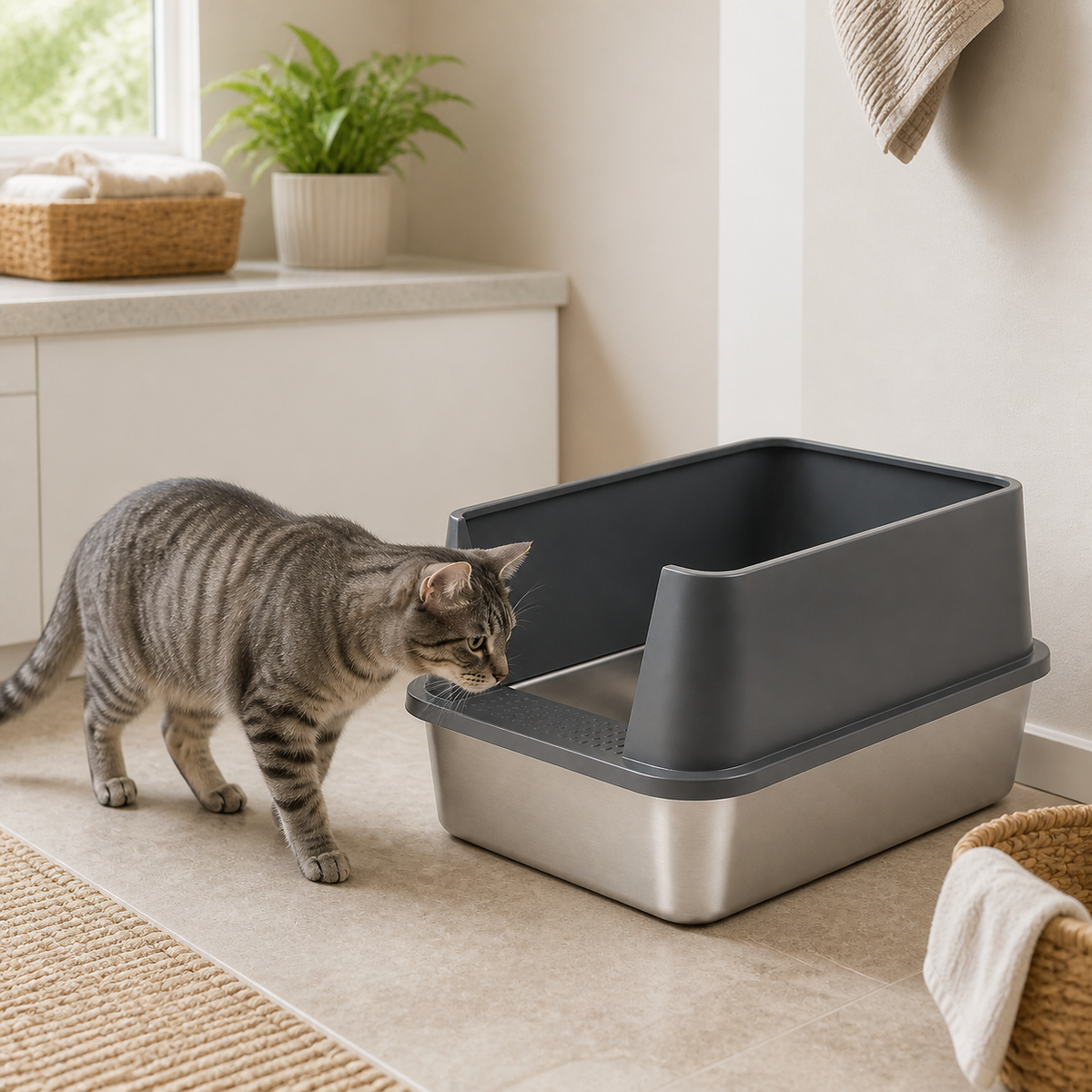
Entry height is a separate decision. A high surround can contain ordinary scatter, but the front still needs to suit the cat’s body and mobility. Kittens, senior cats, and cats with pain or balance changes may need a lower threshold. If stepping in has suddenly become difficult, ask a veterinarian about the change before treating it as a furniture problem.
Protect the approach, the pause, and the exit
Quiet does not mean hidden at the end of a trap. The cat needs enough privacy to pause and dig, plus enough visibility and room to leave if a door opens or another animal appears. Avoid narrow gaps behind sofas, active door swings, and locations beside washers, dryers, furnaces, or vents that can start unexpectedly.
Keep toileting resources away from food and water. If a compact home forces compromises, prioritize a reliable open route and physical separation over a decorative cabinet. The same room-mapping method in the small-space perch and scratch guide applies here: test the whole body and route, not only the product footprint.
Preserve familiar litter while testing the box
Box, location, litter texture, litter depth, scent, liner, and cleaning product are different variables. Changing all of them at once makes avoidance difficult to interpret. Offer the new box with the familiar litter in a suitable separate location, and keep the established box usable while the cat investigates.
Many cats prefer an unscented, fine-grained substrate, but individual history matters. Do not add a fragrance or deodorizing product simply because the human can smell the station. First remove waste, clean the box and surrounding floor appropriately, improve ventilation, and confirm that the substrate itself has not changed.
Important condition
A new substrate, liner, fragrance, or automatic cycle should be offered as a choice—not used to make the familiar toilet suddenly unavailable.
Build care around what you can see and reach
Remove waste at least daily and use that moment to notice the cat’s normal pattern. The Ohio State Indoor Pet Initiative advises daily scooping and regular washing with mild dish detergent. Follow the exact box and litter instructions for a full change, safe cleaning products, drying, liners, filters, and parts that should not be submerged.
A flat double-layer mat can catch ordinary carryout near the entry, but it also needs to be lifted and cleaned underneath. Keep the deep stainless-steel litter scoop dry between uses and inspect the handle and edges. The broader litter collection is useful only after the room, measurements, and maintenance plan are clear.
- Scoop at least once each day and more often when the household setup requires it.
- Replace removed litter only as directed for the exact substrate.
- Wash, rinse, and dry the box without leaving strong cleaner residue.
- Clean the mat, wall edge, scoop, holder, and floor—not only the visible litter surface.
Treat an automatic box as a system, not an upgrade
An automatic litter box adds sensors, motion, electrical parts, compatible litter rules, minimum age or weight limits, app settings, and a cleaning cycle the cat may hear or see. Verify every current requirement for the exact model before use. Never infer safety from capacity, price, or a similar-looking machine.
Keep an accessible conventional box available while an automatic option is introduced and whenever it is off, being cleaned, or behaving unexpectedly. The 78-liter smart self-cleaning litter box should be removed from service immediately if its sensors, motion, or controls do not match the supplied documentation.
Important condition
Straining, repeated unproductive trips, crying, blood, sudden house-soiling, or an abrupt change in urine or stool belongs with a veterinarian. Inability to pass urine can be an emergency; contact a veterinary clinic immediately.
Frequently asked questions
How many litter boxes do two cats need?
A common starting point is three boxes—one per cat plus one—distributed in genuinely separate, accessible locations. Adjust for the cats’ relationships, the number of floors, mobility, and any veterinary guidance.
Do cats prefer covered or uncovered litter boxes?
Many cats use large uncovered boxes comfortably, but individual history and preference matter. Compare usable internal size, entry, ventilation, visibility, cleaning access, and the ability to leave without being blocked. Offer a new format while the familiar box remains available.
Why did my cat suddenly stop using the litter box?
Pain, urinary or digestive illness, mobility change, conflict, a frightening event, a dirty box, or a change in location or litter can all matter. Arrange veterinary advice promptly rather than assuming the cat is being difficult or trying to solve the change with another product.
Make one useful change
Measure your cat and the usable floor of every current box. Then walk each route at the home’s busiest hour and fix the first blocked, noisy, or difficult access point you find.
This journal provides general educational guidance, not veterinary diagnosis. Contact your veterinarian about health changes, pain, distress, or advice for an individual cat.