


Indoor enrichment · 10 min read
Good indoor play is not measured by how long a toy can keep moving. It is measured by whether the cat can watch, choose, pursue, catch something, and settle without the room becoming chaotic.
The AAFP/ISFM environmental needs guidance recommends opportunities for play and predatory behavior and says cats should be able to capture the ‘prey’ intermittently to reduce frustration. This routine turns that principle into a short, supervised sequence you can repeat and adjust.
Decision aid
The 10-minute play plan
Ten minutes is a planning frame, not a quota. Stop earlier when your cat disengages, becomes over-aroused, pants, hides, or shows discomfort.
| Minute | Your job | What to watch |
|---|---|---|
| 0–2 | Observe and start small. | Eyes, ears, head turns, and the distance your cat chooses. |
| 2–5 | Move the toy like one plausible prey type. | Stalking, weight shift, short pursuit, or a clear decision not to engage. |
| 5–7 | Offer short chase paths with safe turns. | Traction, furniture edges, other pets, and rising intensity. |
| 7–8 | Make a physical capture possible. | The cat can pin, grab, or receive a small appropriate reward. |
| 8–10 | Slow the movement and reset the room. | Breathing, body softness, grooming, eating, or walking away calmly. |
Identify the prey pattern your cat follows
One cat tracks a low mouse-like movement along a wall. Another watches an airborne flutter. Another wants the toy to disappear behind a box before committing. Start with the pattern your cat already notices rather than making every toy fast.
The Ohio State Indoor Pet Initiative recommends using the objects and movements an individual cat enjoys and keeping favorite toys special instead of leaving every option out all day. Rotate one variable at a time—height, speed, sound, or cover—so you can tell what changed the response.
- Low and interrupted: mouse-like movement beside cover.
- Short and fluttering: insect- or bird-like movement with pauses.
- Hidden and reappearing: movement under paper, a box edge, or a safe tunnel.
- Food-linked searching: an appropriate puzzle or small tossed food reward when diet allows.
Clear the route before the toy moves
Choose one open section of floor with traction and two or three short routes. Move breakables, loose cords, bags with handles, and unstable objects before the cat is running. Keep stairs, balconies, open windows, hot surfaces, and doors outside the chase path.
In a multi-cat home, individual sessions can reduce interruption and competition. The AAFP/ISFM environmental needs handout specifically notes individual play for multiple cats. Watch who blocks the route, who observes from a distance, and who needs a separate room to participate comfortably.
Make the middle interesting without making it endless
Use bursts: move, pause, disappear, reappear. A cat that freezes may be stalking, not bored. Give the body time to make the next choice. Constant maximum speed often turns a readable game into visual noise.
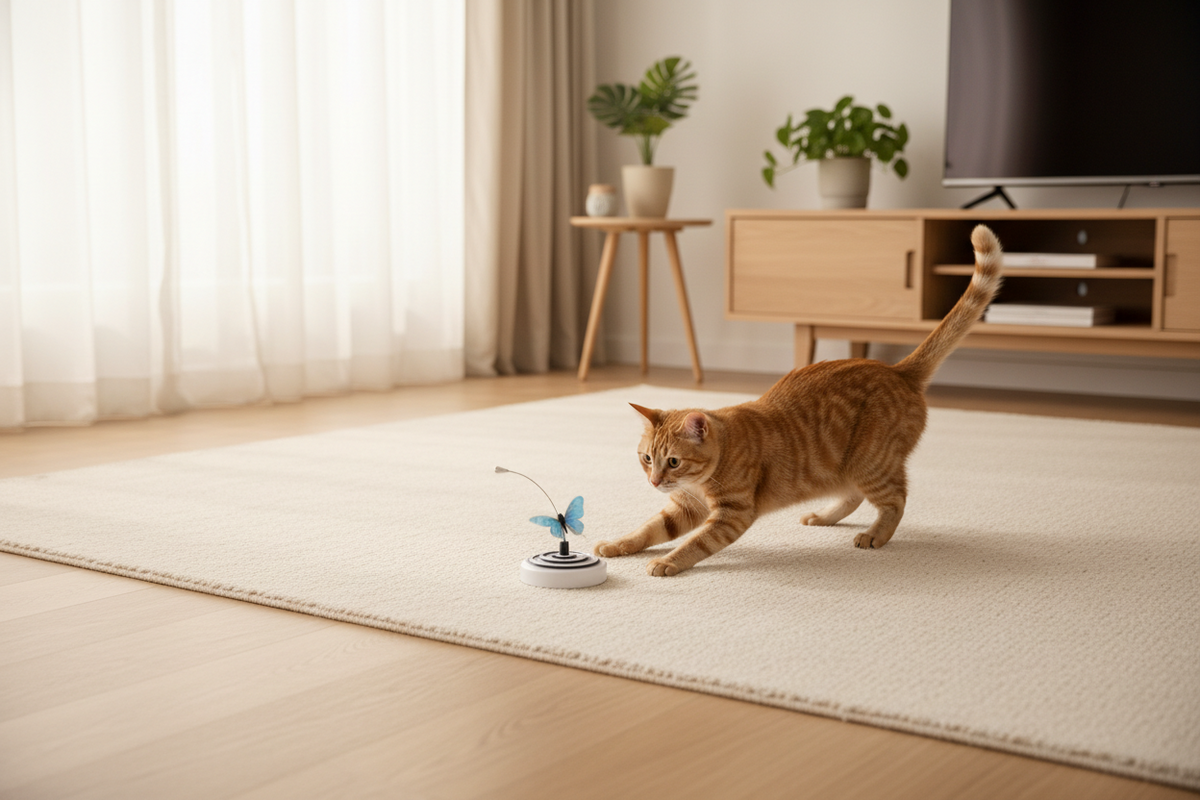
The automatic rotating butterfly toy in the play collection can inspire a fluttering pattern, but the actual product still needs its own inspection. Check the wire, attachment, base, and moving parts before every use; keep the cat from chewing or becoming tangled; and store it when the session ends.
Important condition
A moving product is never a substitute for supervision. Remove any toy with a loose wire, exposed filling, damaged plastic, failing seam, or detachable part that no longer matches the manufacturer’s safe condition.
Use a laser only as one part of the sequence
A laser can create a fast visual chase, but the point itself cannot be captured. Keep sessions short, never aim toward eyes, people, animals, mirrors, or reflective surfaces, and transition to a physical toy or suitable food reward the cat can actually reach.
Ohio State advises stopping laser use if a cat becomes anxious or keeps searching for the light when it is off. The automatic rotating laser toy should be treated with the same caution: verify the exact controls and instructions, supervise the full session, and stop if the cat’s behavior becomes tense, repetitive, or difficult to interrupt.
Let the cat win, then lower the energy
The capture does not need to be dramatic. Let the cat pin the physical toy, grab an appropriate kicker, or find a small food reward when that fits the cat’s diet. The important change is that the chase resolves into something tactile or consumable rather than simply disappearing.
After the capture, make the next movements smaller and less frequent. Put the automatic device away, gather loose attachments, and leave the room readable again. A little grooming, eating, or choosing a rest spot can be a useful sign that the session has moved out of chase mode.
Keep a one-week play log
Record the toy, movement pattern, start time, first sign of interest, and how the session ended. Do not score enthusiasm only by speed. Watching from a box, one careful pounce, or returning for the same pattern tomorrow may be a better fit than frantic pursuit.
Change only one part of the routine every two sessions. If the cat stops playing suddenly, seems painful, has trouble jumping, pants, limps, or shows an abrupt behavior change, pause the experiment and contact a veterinarian. A new toy cannot diagnose a medical or behavioral problem.
- Which motion earned the first head turn?
- Where did the cat choose to stalk?
- Was a physical capture possible?
- Did the cat settle, keep searching, or avoid the room afterward?
Frequently asked questions
How long should I play with my indoor cat?
Use your cat’s response, age, mobility, health, and the toy’s instructions rather than forcing a fixed duration. This ten-minute plan is a short framework; stop earlier if the cat disengages, becomes over-aroused, pants, hides, or shows discomfort.
Are laser toys bad for cats?
A laser can be used cautiously as a brief visual chase, but never aim it at eyes or reflective surfaces. Transition to something the cat can physically catch, and discontinue use if the cat becomes anxious or keeps searching after the light is gone.
Why does my cat watch a toy but not chase it?
Watching can be part of stalking, or the movement may not match that cat’s preferred prey pattern. Slow down, add pauses and cover, try a different movement type, and respect a decision not to engage.
Make one useful change
Clear one short route and run the five-part loop with a physical toy tonight. Write down the first movement that earns your cat’s attention and the action that helps the game end calmly.
This journal provides general educational guidance, not veterinary diagnosis. Contact your veterinarian about health changes, pain, distress, or advice for an individual cat.